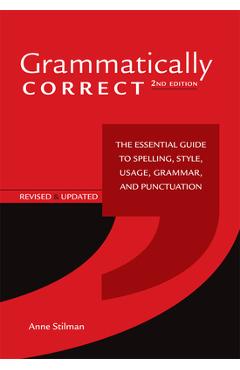
nHow does good writing stand out? nIf its purpose is to convey facts, findings, or instructions, it need be read only once for its content to be clear. If its purpose is to entertain or to provoke thought, it makes readers want to come back for more. n nRevised and updated, this guide covers four essential aspects of good writing: n n - Individual words - spelling variations, hyphenation, frequently confused homonyms, frequently misused words and phrases, irregular plurals and negatives, and uses of capitalization and type style to add special meanings n - Punctuation - the role of each mark in achieving clarity and affecting tone, and demonstration of how misuses can lead to ambiguity n - Syntax and structure - agreement of subject and verb, parallel construction, modifiers, tenses, pronouns, active versus passive voice, and more n - Style - advice on the less hard-and-fast areas of clarity and tone, including sentence length and order, conciseness, simplification, reading level, jargon and cliche s, and subtlety n nFilled with self-test exercises and whimsical literary quotations, Grammatically Correct steers clear of academic stuffiness, focusing instead on practical strategies and intuitive explanations. n nDiscussions are designed to get to the heart of a concept and provide a sufficient sense of when and how to use it, along with examples that show what ambiguities or misinterpretations might result if the rules are not followed. In cases where there is more than one acceptable way to do something, the approach is not to prescribe one over another but simply to describe the options. n nReaders of this book will never break the rules of language again - unintentionally.n